Total Football: A Comprehensive History of World Cup Public Diplomacy
Part I: The First World Cups: Football, Fascism, and the Fight for Global Image (1930–1950)
This is the first part of a series on World Cup Public Diplomacy.
World Cup Public Diplomacy
The World Cup Final is the one of the most watched single sporting matches in human history every four years. Over a billion people tune in to watch twenty-two players push for the pinnacle of soccer— known to most as football, fútbol, futebol and more. Breaths are drawn for each kick of the ball and in a world of division, fans across the globe are united for a little over ninety minutes to enjoy the beautiful game. Beyond the chance to lift the shining gold trophy, hosting the World Cup offers nations the indispensable opportunity to engage foreign audiences and conduct one of the largest public diplomacy campaigns on the planet.
Plenty of scholarship already exists on the individual importance of each World Cup competition and overall soccer diplomacy, but until recent months, few scholars spent significant efforts to bridge these topics together. One notable exception is Soccer Diplomacy: International Relations and Football since 1914, in which experts on various subjects provide a strong overview of football’s role in international relations. Fans looking for a more modern read on the subject rife with personal perspectives can opt to read World Cup Fever: A Soccer Journey in Nine Tournaments by Simon Kuper, published by Simon & Schuster in March 2026.
This paper seeks to synthesize nearly a century of World Cup history and linkage to public diplomacy in a condensed but comprehensive report. Each nation hosted the competition with its own desire to project its image and communicate a core message to other countries beyond its footballing capabilities. Although the scope of this paper will focus mostly on forces outside of football, a breakdown of the dates and scores of each final will be presented to pair crucial context from the pitch with each public diplomacy mission. Each tournament brought distinct opportunities and challenges, but recurring patterns emerge: corruption in the bidding process, win-at-all costs strategies, promotion of national pride, pursuit of economic investment, efforts to ease geopolitical tensions and removing the memories of war.
A Framework for Understanding World Cup Public Diplomacy
This paper draws upon the work of Nicholas Cull in his article “Public Diplomacy: Lessons from the Past” to outline core functions of public diplomacy. Public diplomacy is designed to promote a country’s image, culture, status as an effective negotiating partner, national security and ability to counter misinformation. Approaches can be proactive — hosting events and visits that engage shared values; reactive — focusing on damage control, social media, press statements on current events, and travel advisories; or relationship-building — offering scholarships to foreign students, cooperating with government officials and development aid to economic sectors. The five components of public diplomacy include listening, advocacy, cultural diplomacy, exchange and international broadcasting. As outlined in Soccer Diplomacy, World Cup public diplomacy can be understood as nation-states engaging both state and non-state actors to influence foreign perceptions, shift regional power dynamics, and situate football within transnational contexts.
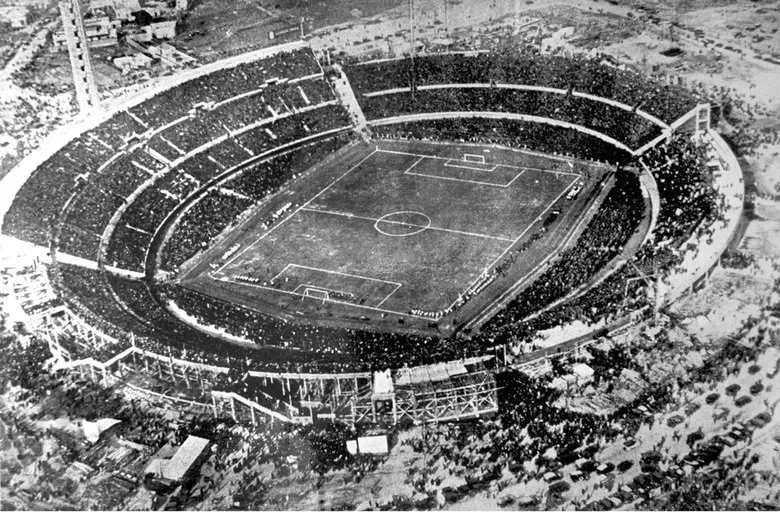
The Estadio Centenario in Montevideo in 1930, capable of holding 90,000 fans, dubbed “the temple of football.”
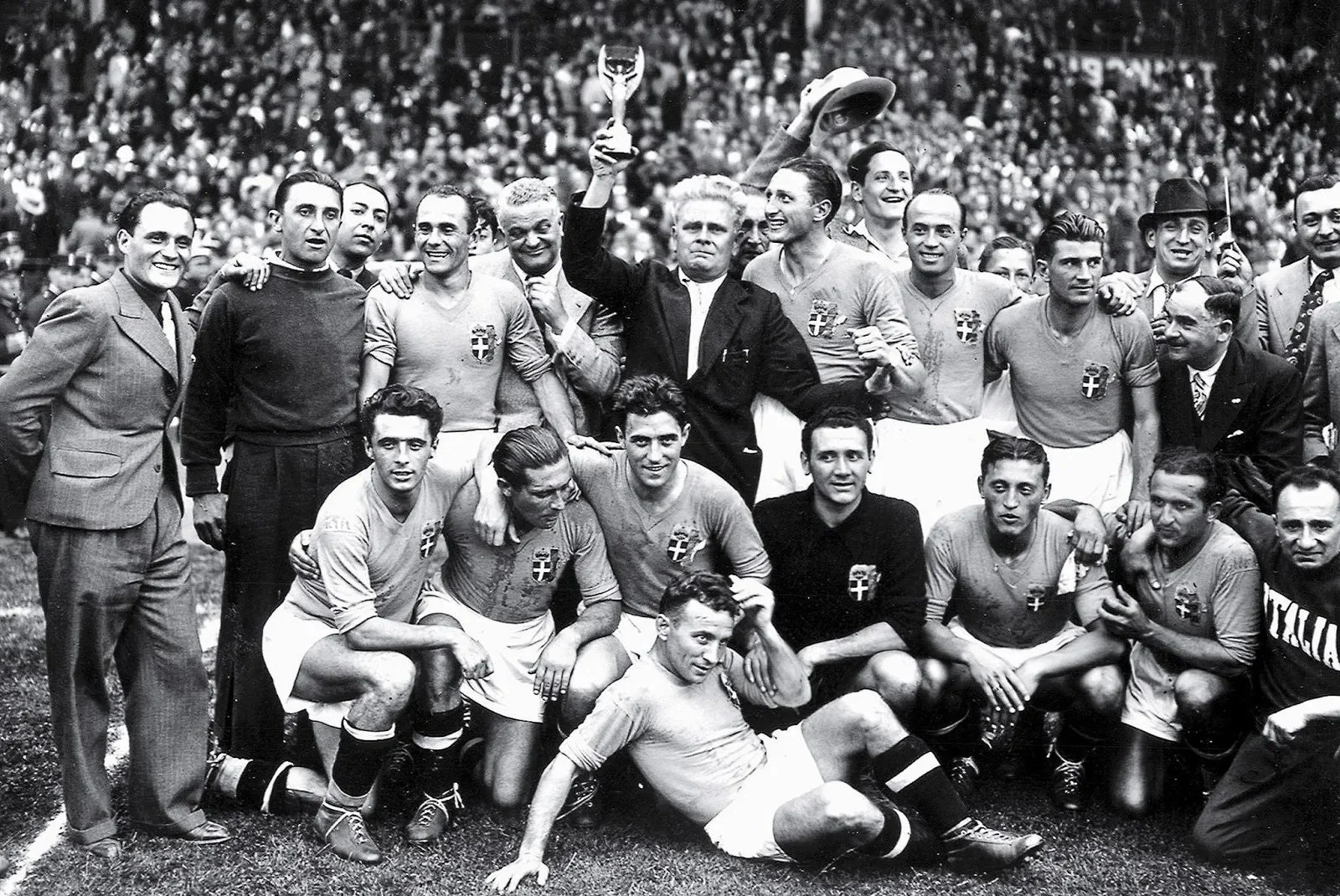
Italy celebrates their 1934 World Cup Victory win Benito Mussolini, il Duce.
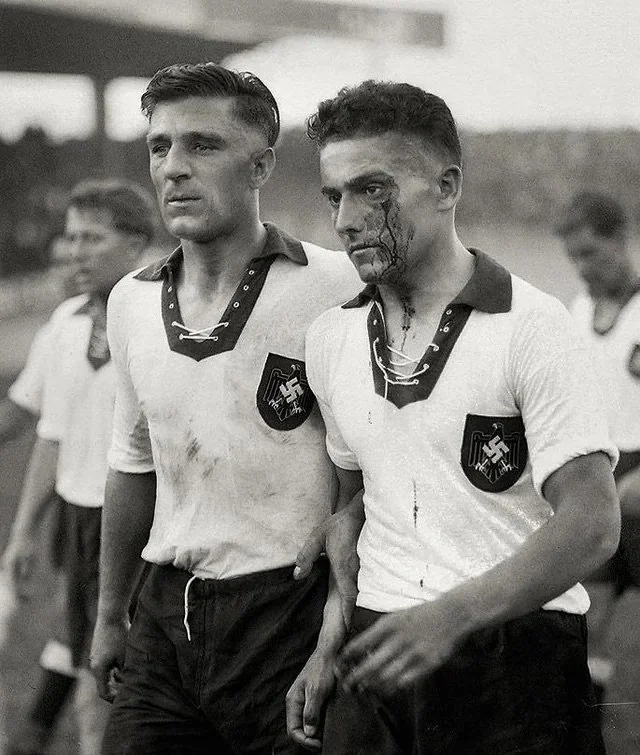
A bloodied German footballer leaves the pitch at Parc de Princes in the 1938 World Cup in France.
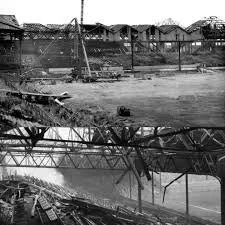
Manchester United's famed Old Trafford sits in ruins, bombed by German air forces during WWII and a hiatus for World Cup matches.
Uruguay 1930: Origins
July 30, 1930, Uruguay (4) - Argentina (2)
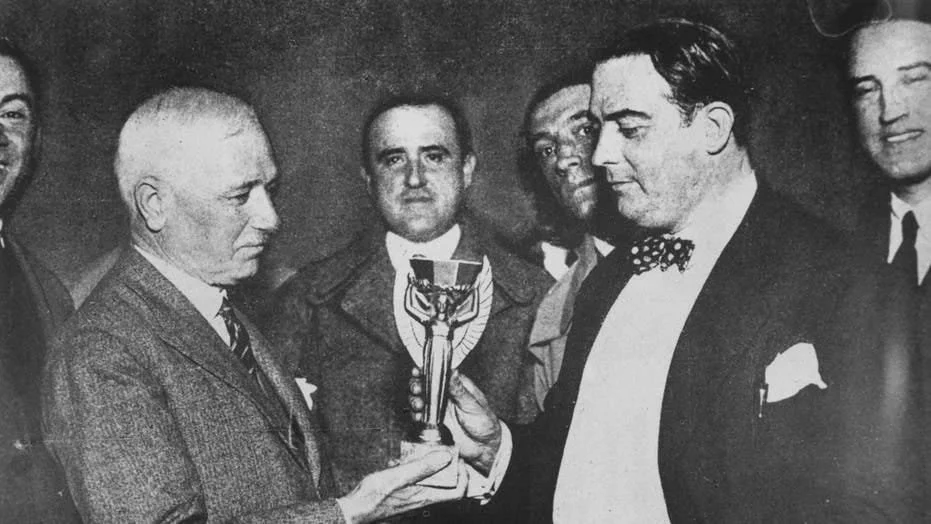
The International Federation of Association Football (FIFA) came to existence in May 1904 when seven national soccer associations —Belgium, Denmark, France, Netherlands, Spain, Sweden, and Switzerland— sought to “foster friendly relations” under one footballing governing body. This milestone came a few years after the first Olympics but several decades into the growth of men’s association football and beginning of international friendlies. Football was first played by amateurs at the 1900 Paris Olympics, and by 1920, FIFA recognized an opportunity to boost the appeal of the sport on a professional level and host its own world championship for the sport. Thirteen nations from three continents spearheaded the planning for the inaugural competition to be held in Uruguay, which won gold medals in the Olympic football competition in both 1924 and 1928, for its centennial celebrations in 1930. Spain, Sweden, Hungary, Italy and the Netherlands all had their bids beat by the burgeoning champions.
Uruguay’s national football federation covered the travel and accommodation costs for participating teams, though many European nations faced economic hardships from the Great Depression and declined the invitation for the long voyage. The tournament, then an invitational competition without qualification, featured Argentina, Brazil, Belgium, Bolivia, Chile, France, Mexico, Paraguay, Peru, Romania, the United States, Uruguay, and Yugoslavia. Montevideo, the nation’s sprawling seaside capital, held all games and hosted the final in the 90,000 Estadio Centenario, dubbed “the temple of football.” In a thrilling grand finale full of drama and tensions between the rival neighbors, Uruguay mounted a comeback to defeat Argentina. It showcased to the world that a small South American country had the capacity to host a global event and build the requisite infrastructure all while flaunting its rich culture and generating economic investment. The success of this tournament formed the blueprint for following host nations.
Italy 1934: Fascism Enters Football
June 10, 1934, Italy (2) - Czechoslovakia (1)
Italy and its fascist leader, Benito Mussolini, helped the World Cup return to Europe in 1934 to the satisfaction of its continental counterparts. The previous host Uruguay felt less enthused, and elected to boycott the competition in protest of the European nations which declined its invitation four years earlier. Uruguay’s boycott would be the first, but not last, over the organizing of the World Cup. Nations from the United Kingdom also skipped the tournament to prioritize their 1934 Home Championship. Mussolini viewed the competition as a propaganda opportunity to convince the world that fascism made his nation stronger than ever. The trophy itself was six times larger than its predecessor and renamed the “Coppa Del Duce.” Matches were marred by allegations of biased officiating, which included the first replay of a World Cup quarterfinal that enabled Italy to advance. Mussolini delivered pep talks to Italy’s team and watched each game from the stands. When the Azzurri claimed victory in a sloppy final under rampant allegations of match fixing at the Fascist National Party Stadium in Rome, Mussolini’s newspaper Il Popolo d’Italia proclaimed: “In the name and in the presence of the Duce, the Azzurri win a new world title.” Western nations were not quite convinced by Italy’s ideological display of force or footballing, but Mussolini proved the World Cup could serve as a potent political platform.
France 1938: Les Bleus Charm and Rising Tensions
June 19, 1938, Italy (4) - Hungary (2)
France recognized the diplomatic power of football as early as 1920, when “the French Ministry for Foreign Affairs created a special section within its propaganda services in the aims of fighting the image of a postwar exhausted France, utilizing soccer within its efforts.” By 1938, the specter of fascism loomed over the European continent and seeped its way into the tournament hosted by the French Football Federation. Austria’s famed “Wunderteam” were forced to merge with Germany following the Anschluss. Players swapped their nation’s kits red and white kits with the Reich’s Nazi uniform. Germany, however, suffered an early and embarrassing first round exit. Italian coach Vittorio Pozzo led his team to the first repeat victory in a thrilling final. The victory, on friendly fascist soil, offered Mussolini another opportunity to boast his nation’s might, and the developing axis between him and his German counterpart offered a glimpse into the sinister alliances soon to devastate the continent. France, for its part, put together a marvelous showing of its country’s idyllic charm with games in ten cities spanning different regions. From the beachside stadiums to the Parc de Princes in Paris, all would fall under Axis rule a few years later. Twelve nations from Europe, Asia, South America and Central America competed, although Uruguay maintained its boycott. The field was the most geographically diverse to date, a true preview into the future of World Cups with players hailing from six continents.
Second World War 1942 - 1946: Hiatus
During the Second World War, the World Cup followed suit of other major global competitions such as the Olympics and went on hiatus. War, not football, occupied the minds and bodies of people in every corner of the globe, reeling from catastrophic violence and destruction. No repeats of friendly matches occurred in the same vein as the famous Christmas Truce during the First World War, in which a group of English and German soldiers reportedly enjoyed a spirited but friendly match of football in No Man’s Land on Christmas Day. German and English accounts differ on the exact nature of the match, or string of matches, in which soldiers crossed into No Man’s Land to exchange gifts and enjoy the beautiful game together. Regardless, their overlapping narratives demonstrated the ultimate power of football as a force for unity. The next World Cup would unfold in a different decade, in a world reshaped by war and its aftermath.
Part II: 1950–1966 (coming next week)
References
Dichter, Heather L., 'Introduction', in Heather L. Dichter (ed.), Soccer Diplomacy: International Relations and Football since 1914 (Lexington, KY, 2020; online edn, Kentucky Scholarship Online, 21 Jan. 2021), https://doi.org/10.5810/kentucky/9780813179513.003.0001, accessed 27 Apr. 2024.
Cull, Nicholas J. “Public Diplomacy: Lessons from the Past.” CP Perspectives on Public Diplomacy, 2010. https://uscpublicdiplomacy.org/sites/uscpublicdiplomacy.org/files/legacy/publications/perspectives/CPDPerspectivesLessons.pdf
Leonard, Mark. “Public Diplomacy.” fpc.org, 2002. https://fpc.org.uk/wp-content/uploads/2006/09/35.pdf.
Nag, Utathya. “The First FIFA World Cup and Its Antwerp Olympics 1920 Connection.” Olympics.com, September 7, 2022. https://olympics.com/en/news/first-fifa-world-cup-football-1930-uruguay-champion-records.
Hazal Degirmencioglu, Melis. “World Cup during World War 2.” Pacific Atrocities Education. Accessed April 27, 2024. https://www.pacificatrocities.org/blog/world-cup-during-world-war-2.
Hart, Jim. “When the World Cup Rolled into Fascist Italy in 1934.” These Football Times, May 17, 2018. https://thesefootballtimes.co/2016/07/27/when-the-world-cup-rolled-into-fascist-italy-in-1934/.
Duke, Greg. “Ten Shocking World Cup Moments.” CNN, June 2, 2010. http://edition.cnn.com/2010/SPORT/football/05/30/football.world.cup.controversies/index.html.
Anspach, Emma, and Hilah Almog. “The 1934 World Cup.” Soccer Politics / The Politics of Football, October 15, 2013. https://sites.duke.edu/wcwp/research-projects/football-and-politics-in-europe-1930s-1950s/mussolinis-football/the-1934-world-cup/.
Miller, Nick. “The Story of the First World War Christmas Truce: How Much Football Was Actually Played?” The Athletic, December 25, 2023. https://theathletic.com/5155123/2023/12/25/christmas-truce-world-war-one-football/.