Total Football: A Comprehensive History of World Cup Public Diplomacy
Part II: Power and Perception: The Postwar World Cup and the Politics of Image (1950–1966)
This is the second part of a series on World Cup Public Diplomacy.
Brazil 1950: A South American Showdown
June 16, 1950, Uruguay (2) - Brazil (1)
Twelve years after the last tournament, the 1950 World Cup in Brazil gave South American nations a platform to assert a greater voice at the diplomatic tables of both FIFA and other international organizations, such as the newly formed United Nations which omitted Brazil from permanent membership. The destruction of war mostly spared the physical infrastructure of these countries, and Brazil put its heart and soul into the preparation. Brazil’s Ministry of Foreign Affairs envisioned the competition as a prime opportunity to bring prestige to their style of football and project its nation's capabilities on the global stage.
Although several European teams qualified, many appeared weakened by the lingering effects of war and not yet back to their footballing best. European journalists decried the unfairness of this advantage in news reports. Brazil’s ambitions culminated in catastrophe during its tragic defeat at the hands of rivals Uruguay in the World Cup Final in Rio de Janeiro, spectated by nearly 200,000 fans. The Maracanaço, translating to “Maracaña Smash”in Portuguese, turned into a profound source of national collective grief and a failure of Brazil’s take the top spot on home soil. Brazil’s loss only temporarily undercut its sporting dominance, but its broader effort to ascend to global postwar leadership was derailed.
Switzerland 1954: Sports Tourism Blooms
July 4, 1954, West Germany (3) - Hungary (2)
Sporting tourism had been one of Switzerland’s main public diplomacy strategies dating back to the 19th century. Skiing, hiking and other outdoor recreation activities led to a boom in the hotelier industry and alpine towns and cities including Geneva, Zurich and Zermatt. Overnight stays by foreign visitors saw a 30% increase from 7,707 in 1938 to 10,856 in 1953 as a result of these efforts. One unique facet of Switzerland’s tournament was the organizing committee’s decision to hold a one-week break in the middle of the tournament to encourage foreign tourists to explore the country. Swiss finance, transportation and tourism authorities undertook a collaborative campaign to improve infrastructure and better accommodate international visitors attending the tournament. A fifteen-member organizing committee led outreach efforts by disseminating messaging to journalists on every continent, especially those in South America, and publishing official bulletins in four languages. It represented one of the most institutionalized organizing and planning committees and created a playbook for future hosts to focus on more than football. In the final match of the tournament, newly-formed West Germany upset Hungary in the “Miracle of the Bern,” a symbolic victory for a nation still finding its identity in the rubble of WWII.
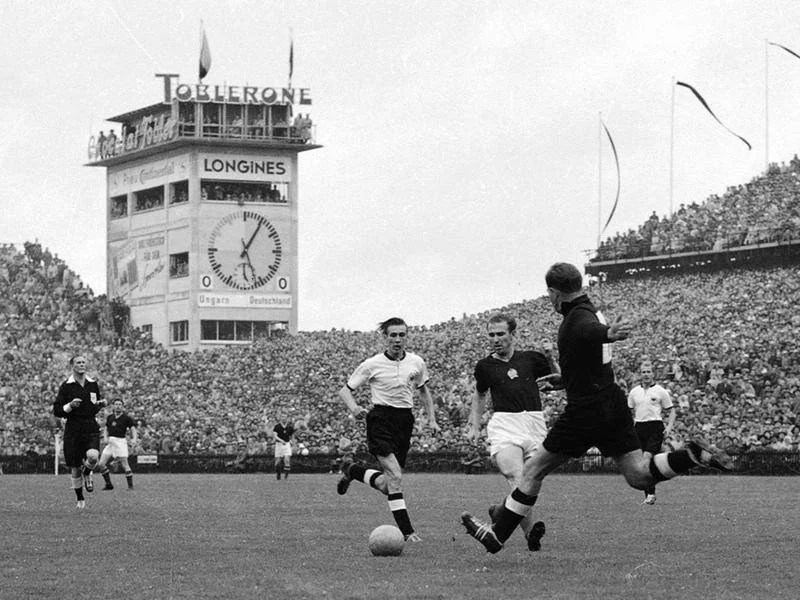
Players clash at the "Miracle at the Bern" in 1954 with recognizable global Swiss brands displayed on a clocktower in the background.
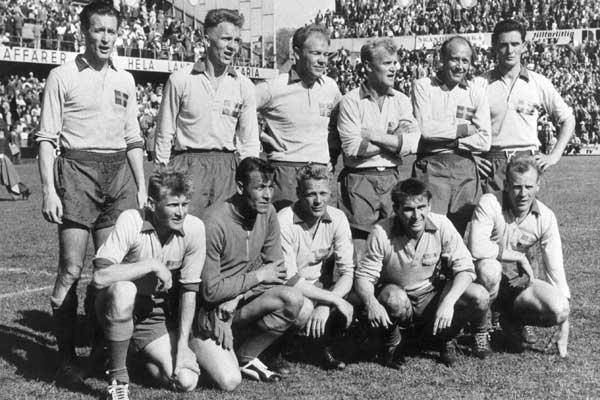
The sturdy IKEA defense of Sweden stayed strong until meeting Brazil and rising star Pelé in the 1958 final.
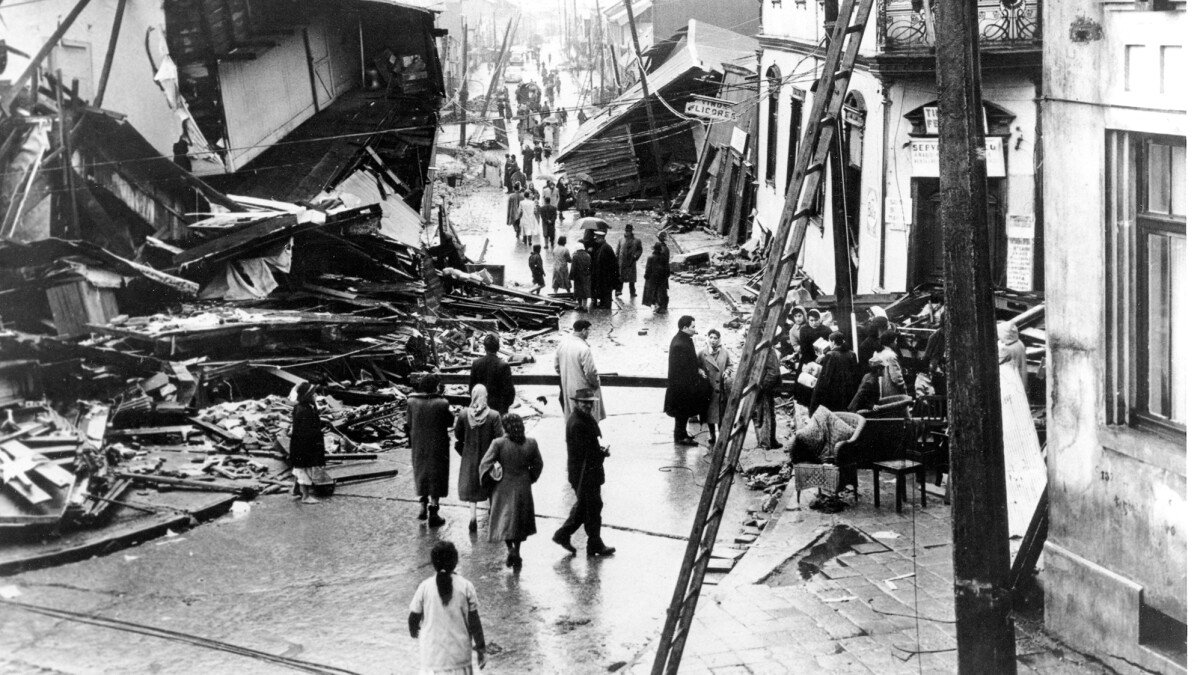
Communities in Chile were devastated by the 1960 earthquake that registered 9.5 on the Richter Scale and jeopardized the 1962 tournament.
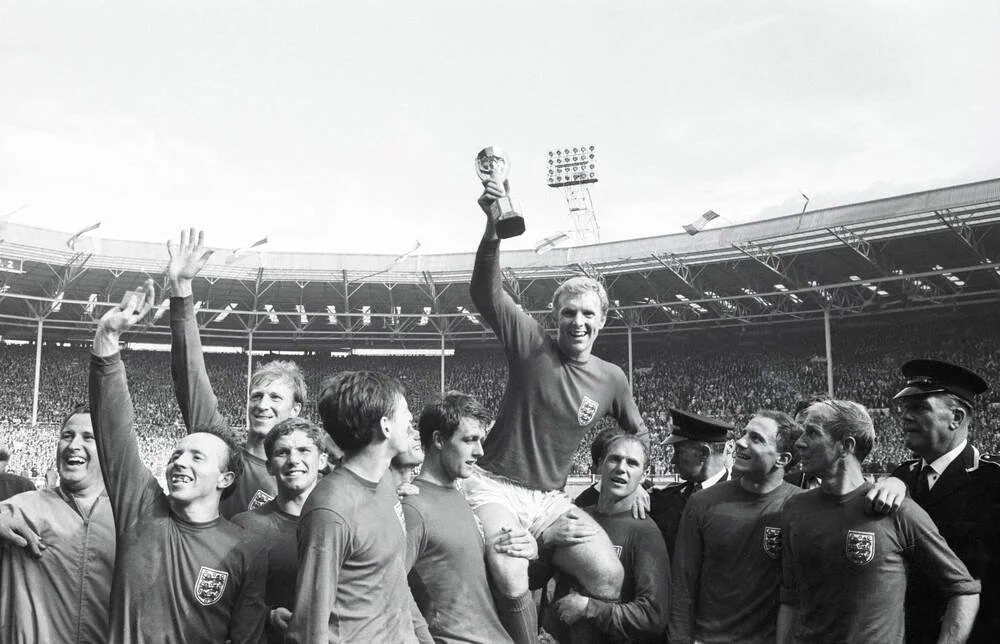
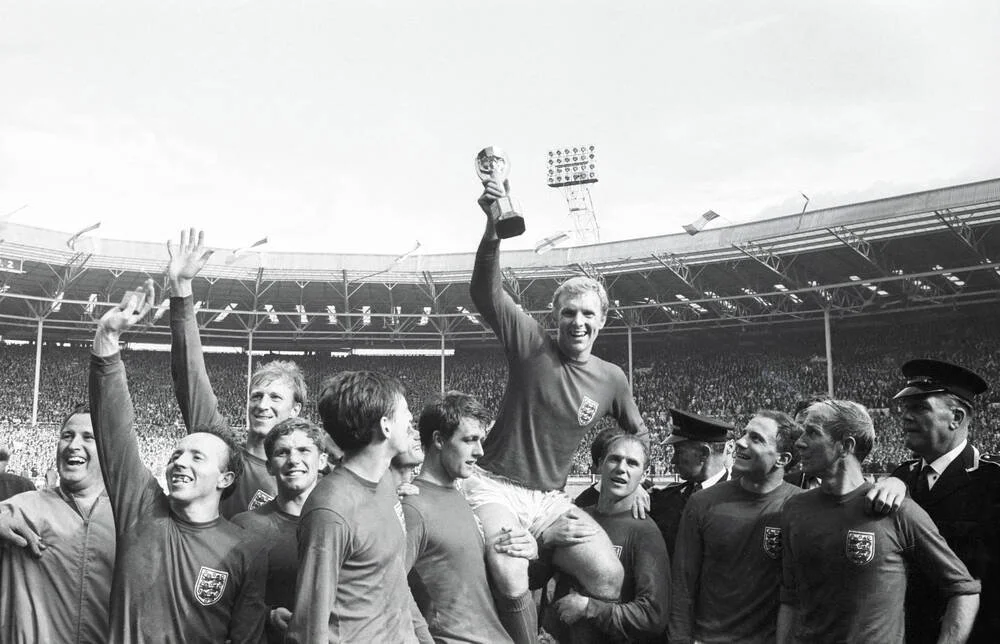
In one of perhaps the most famous World Cup images, England captain Bobby Moore proudly lifts the recently lost-and-found Jules Rismet Trophy in 1966.
Sweden 1958: Exporting an Industrial Model
June 29, 1958, Brazil (5) - Sweden (2)
Amid the industrial boom of the 1950s, Sweden’s functionalist ethos emerged as a model for both economic organization and footballing philosophy. Companies like Ikea were growing from a small domestic retailer to a globally-recognized brand pioneering flat-pack design and efficient distribution which expanded opportunities for global shipping. The company gained a reputation for making products that were simple yet strong, a philosophy shared by Sweden’s national team. Though matches in the previous World Cup were the first broadcast in black and white across Eurovision networks, the 1958 World Cup marked a turning point in global media. Television ownership increased significantly by the end of the decade, extending viewership and the tournament’s reach to audiences far beyond the stadium and radio broadcasts.
Sweden’s disciplined defense received a walloping in the final against Brazil and their electrifying 17-year old star Pele, a player who would go on to define Brazilian football for generations. As described in the Sports Illustrated article “The Samba No One Could Match” by John Mulliken, the style of “artistic, dazzling Brazilians” stood in direct contrast to “the vigor of the straight-shooting Swedes.” Sweden put on a performance of modern industrial efficiency, while Brazil captured the global imagination with flair, each representative of the nation’s unique identities. The growth of broadcast television would further amplify the platform for host nations to project their own unique brand. Broadcasting World Cup games also allowed matches to be a time capsule for future generations – or sources of conspiracy, as premised in the documentary “Conspiracy 1958” released as a hoax by journalists who tried to convince Swedes that the games were staged by FIFA and the CIA.
Chile 1962: A Winning Bid Shaken by Disaster
June 17, 1962, Brazil (3) - Czechoslovakia (1)
After two consecutive competitions in Europe, Chile and Argentina competed intensely at the 1956 FIFA Congress to bring the World Cup back to South America. Argentina entered as the favorite, with a far more developed transportation network and stadium infrastructure. Leading the effort for Chile was Carlos Dittborn, a former CONMEBOL head possessing diplomatic experience. Dittborn made a compelling pitch for his nation to host in a short fifteen-minute speech encompassing four points: “our consistent record in attending the tournaments and congresses organized by FIFA; the institutional and political stability of our country; our nation’s tolerance of beliefs, races and other ideas and its sporting climate; and that article of the FIFA Statutes.”
His argument resonated across ideological lines. Chile made direct overtures to the Soviet Union on its tolerance for Socialist and Communist parties and to the United States on its westernized and vibrant labor economy. The positioning as a neutral partner won the votes of both competing Cold War superpowers. Football officials looking to host the World Cup acted as informal diplomats who learned to move beyond logistical plans and think strategically about their nation’s identity and political alignment.
Winning the bid proved easier than hosting it. A series of devastating earthquakes reaching 9.5 on the Richter scale – the deadliest on record – rocked Chile in spring 1960. Hundreds of thousands were left homeless and at least 2,000 were killed. Entire towns and villages were fully leveled and many cities were nearly destroyed. FIFA and regional football associations joined together to provide significant developmental assistance to ensure the tournament could proceed as planned.
Once the games were underway, Brazil continued its dominance and once again hoisted the trophy in a defiant showing of footballing mastery. For Chile, recovering from national disaster to host the game demonstrated the country’s resilience and abilities to leverage an allied coalition of support within the international community to overcome adversity.
England 1966: Football Comes Home
July 30, 1966, England (4) - West Germany (2)
Diplomatic tensions enveloped England’s 1966 World Cup in a grey cloud long before matches began. Mayhem first arose when the Jules Rimet trophy was stolen and found after 7 days wrapped in bushes in a London neighborhood by a dog and local hero named Pickles. The competition coincided with the 900th anniversary of the Norman conquest. Public diplomacy disputes preceded any football matters when French President Charles de Gaulle was disinvited from the ceremony at Hastings scheduled for October over his NATO and SEATO quarrels. A number of nations took up their grievances with England and refused to participate in the competition, including all African nations after being denied a guaranteed spot in a strong showing of pan-African solidarity. The Confédération Africaine de Football (CAF) also protested apartheid in South Africa and were deeply angered by British officials unwilling to address racial segregation and settler violence. North Korea’s acceptance stirred great controversy in London with concerns over an unrecognized bellicose nation being allowed to represent the Asian delegation. Behind the scenes, FIFA President Sir Stanley Rou played an activist role both in allaying concerns over North Korea’s participation and discouraging African nations from using the tournament as a forum to express their shared political ambitions and opposition to apartheid.
Incidents on the pitch also deepened animosity between England and South American nations. After a gritty 1-0 win semifinal win against Argentina, England gaffer Sir Alf Ramsey said Argentinian players came to “act as animals” and drew significant backlash from South American newspapers and Argentinian officials. According to a British diplomat at the embassy in Buenos Aires, the comments sparked “a wave of anti-British feeling among football fans, the effect of which was felt throughout the country.” Officials even exchanged heated remarks on the Falkland Islands which would become the site of direct armed conflict between the two nations just twenty years later. Staying above the noise, England players lifted the World Cup trophy following a hard-fought final against West Germany: football had come home. Newspapers in Latin America accused FIFA and the England FA of deliberate referee corruption to make the moment happen. British diplomats in the Foreign Office elected remained mum on the allegations and allowed the anger to pass: football had finally come home
Part III: 1970–1986 (coming soon)
References
Astruc, Clément. “Beyond the Maracanazo: The World Cup, Diplomacy and the International Exposure of Brazilian Football in 1950.” Soccer & Society 21, no. 8 (2020): 861–75. doi:10.1080/14660970.2020.1793622
Vonnard, Philippe, and Gregory Quin. “MORE THAN JUST FOOTBALL. REFLECTIONS ON THE CASE OF THE 1954 WORLD CUP IN SWITZERLAND.” Cairn.info, 2018. https://serval.unil.ch/resource/serval:BIB_9211563AAC86.P001/REF.pdf.
Golforoush, Danial. “The Story of 1958 World Cup Final: Industrialization and Football.” LinkedIn, June 22, 2018. https://www.linkedin.com/pulse/story-1958-world-cup-final-industrialization-football-golforoush.
Mulliken, John. “The Samba No One Could Natch .” SI.com, July 7, 1958. https://vault.si.com/vault/1958/07/07/the-samba-no-one-could-match.
“Victory from the Depths of Suffering: Chile’s 1962 World Cup: Part 1.” Breaking The Lines, September 25, 2019. https://breakingthelines.com/historical/victory-from-the-depths-of-suffering-chiles-1962-world-cup-part-1/.
Trowbridge, Ben. “Commemorating 1066 in 1966, a Diplomatic Dilemma?” History of government, September 8, 2016. https://history.blog.gov.uk/2016/09/08/commemorating-1066-in-1966-a-diplomatic-dilemma/.
Rofe, J. S., & Tomlinson, A. (2020). The Untold Story of FIFA’s Diplomacy and the 1966 World Cup: North Korea, Africa and Sir Stanley Rous. The International History Review, 42(3), 505–525. https://doi.org/10.1080/07075332.2019.1593218
Dunton, Mark. “The 1966 World Cup and Diplomatic Games.” The National Archives blog, July 29, 2016.