Total Football: A Comprehensive History of World Cup Public Diplomacy
Part IV: The Era of Globalization Deepens Connections (1990 - 2006)
This is the fourth part of a series on World Cup Public Diplomacy.
Italy 1990: Simple is Beautiful
July 8, 1990, West Germany (1) - Argentina (0)
Italy hosted its first World Cup since the fall of Benito Mussolini in 1990, seeking to highlight its cultural sophistication and footballing tradition. Football in Italy has long served as a “vehicle of social integration, social mobility and local identity” with Sunday matches replacing mass in some towns and villages. The tournament emphasized stylish branding, with the sleek “Italia 90” logo covering advertisements worldwide to attract interest in Italy’s renowned designer fashion industry. During the bidding process in 1984, the Soviet Union were Italy’s primary rivals, so the competition also marked one of the final Cold War era competitions for hosting rights.
Italia ‘90 was designed to be a return to simplicity, shifting the spotlight to the spectacle of football and a tournament steeped in tradition while shying away from global tensions and corruption. Fans played kickabouts in city squares, slept in whichever hotels had enough rooms left, and enjoyed matches in a less overtly political context but rife with rich sporting history. Heavy media presence and commercial success sold the tournament well as a product to global audiences, with merchandise and fashion especially garnering more attention.
Italy, to its great displeasure as hosts, lost in the semi-finals to Diego Maradona’s strong Argentina side, who then lost to West Germany in the first final to feature the same two teams as the previous tournament. Talisman Roberto Baggio led Italy’s well-dressed team squad during the third place match against England, in which all 22 players received their medals and stood shoulder-to-shoulder with floral bouquets, bowing to rapturous applause from fans of both teams in a rare moment of friendship and mutual admiration for the beautiful game.
United States 1994: It’s Called Soccer Now
July 17, 1994, Brazil (0) - Italy (0); penalties after Extra Time, 3-2
The decision to award the 1994 World Cup to the United States surprised many in the global “soccer” community. It represented an expansion into a new untapped market, one of the world’s largest, with potential for the game to grow exponentially from sea to shining sea.. American diplomat Henry Kissinger served as one of the prominent figures backing the bid,
whose European background and international friendships with heads of state and FIFA officials helped secure hosting rights. Kissinger served on the organizing committee which received its mandate in a Congressionally approved joint resolution passed in 1987: “a tremendous impetus to national and international tourism, because the games would bring people from all nations together in friendly competition and permit these people to experience, first hand, the American way of life.” America’s major first foray into football encompassed a coordinated network of 26 federal agencies involved in achieving national objectives through strategic public diplomacy outcomes. It was a chance to show the world that the United States could be serious about soccer while cementing its global hegemony over sport.
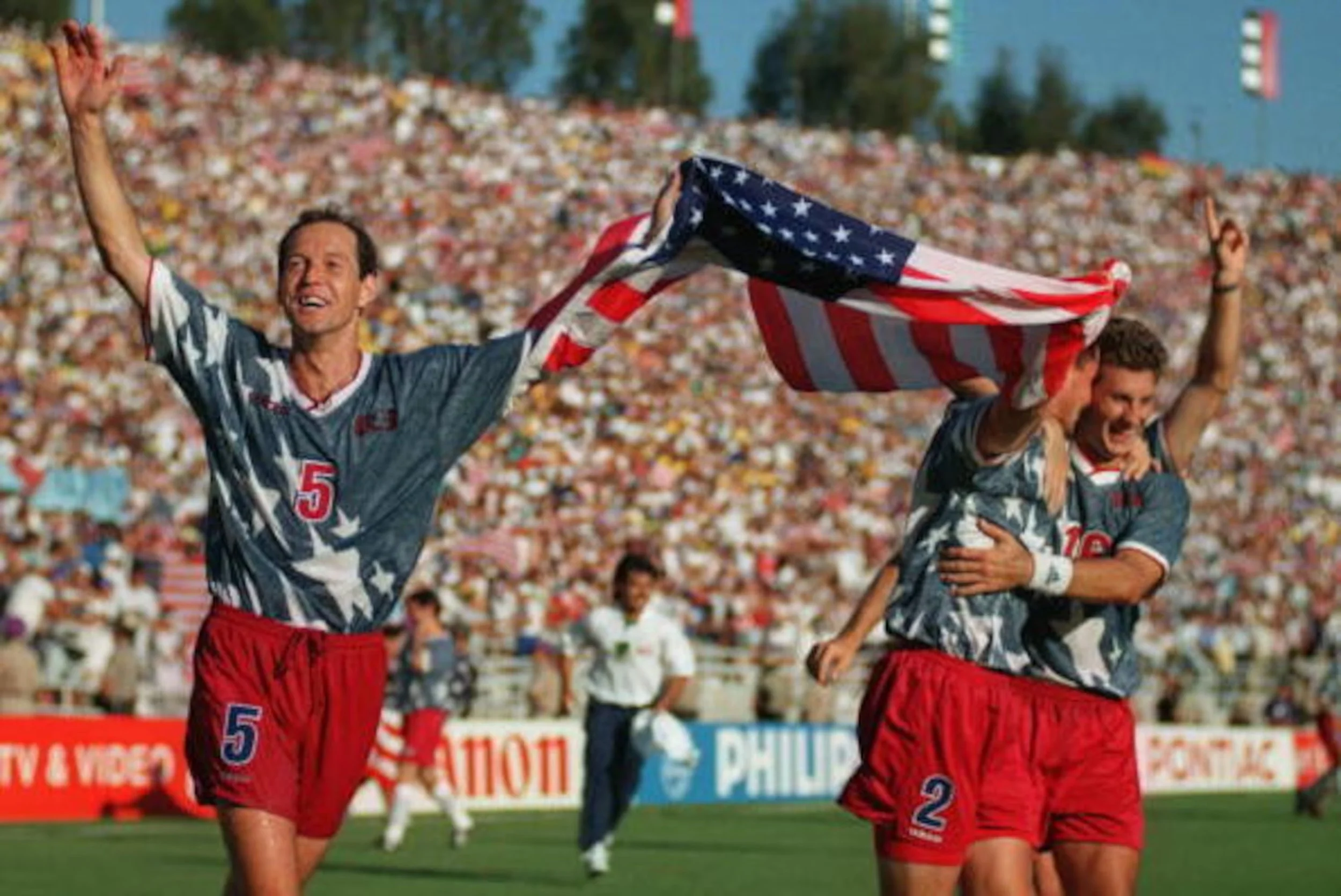
American media outlets from The New York Times to Sports Illustrated framed the tournament from a nationalist lens in a post-Cold War context, highlighting the success of the U.S. Men’s National Team as an underdog story of Horatio Alger proportions. Better than expected performances brought the USMNT into the knockout stages for the first time since 1930, but in an unpatriotic twist of fate, eventual winners Brazil knocked out the The Stars & Stripes on national holiday July 4th.
Though the USMNT’s results on the pitch may have fallen short of expectations, real fireworks came from the tournament generating record revenue. Economists estimated the commercial impact of the tournament reached nearly $4 billion, with games in nine cities from coast-to-coast and corporations including Coca-Cola, Mastercard, General Motors and McDonald’s playing a central role as official sponsors. Fans from at home and abroad showed up in full force and set a record for cumulative attendance with over 3.5 million attendees blowing away the previous record of just over one million. The United States’ first (but not last) time as host proved how the World Cup could function as a platform for integrating new nations into the global football economy while achieving commercial success and public diplomacy objectives through a coordinated public-private sector approach.
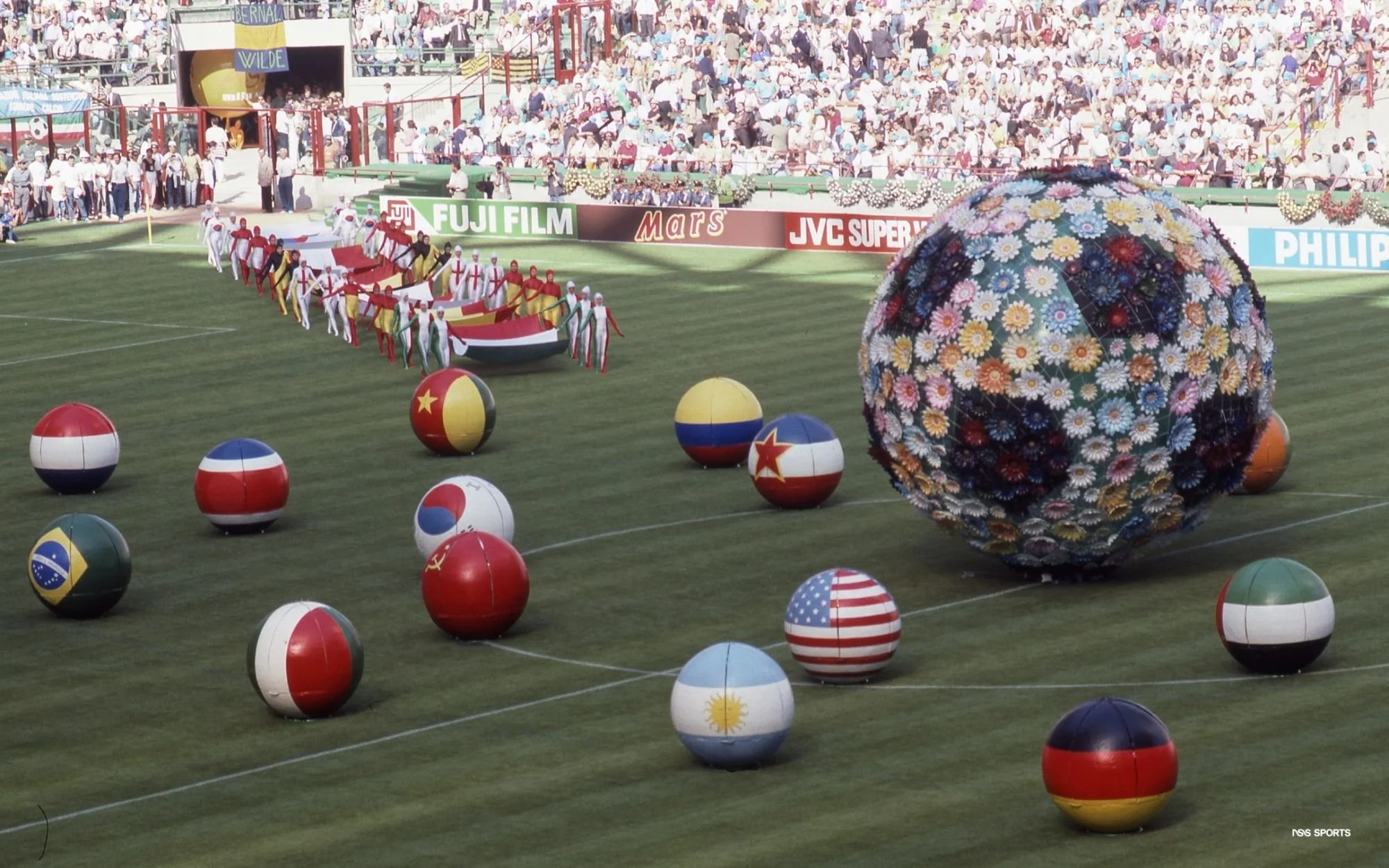
The San Siro is turned into a stylish catwalk at the OpeninG Ceremony of the 1990 World Cup in Italy.
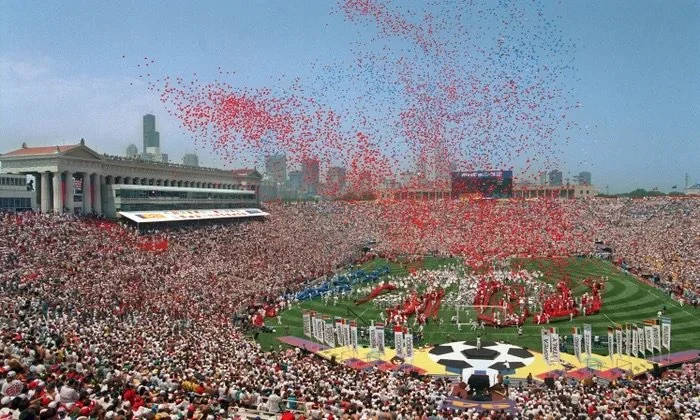
Los Angeles looms in the background as over 100,000 fans fill the Rose Bowl during the 1994 USA World Cup.
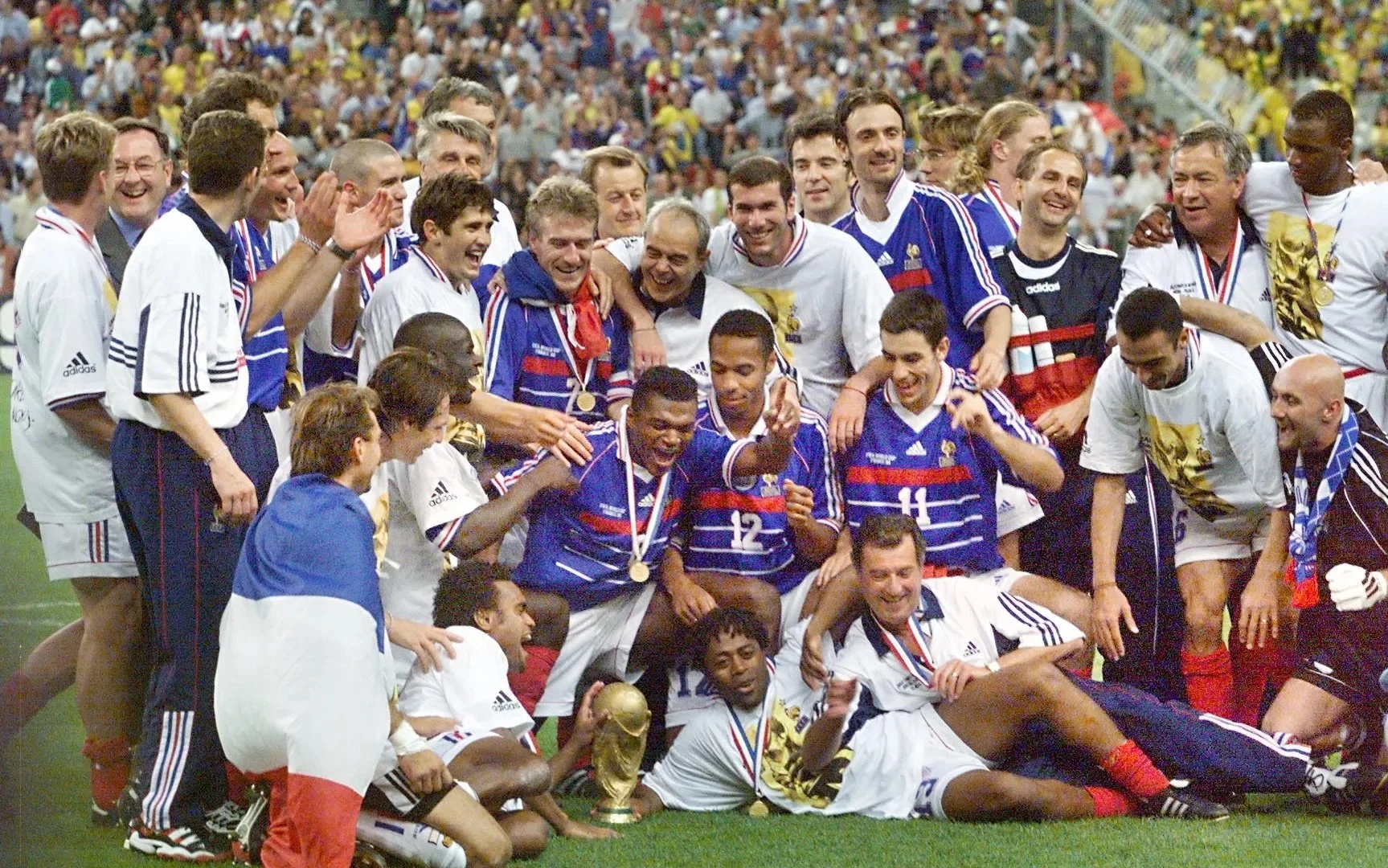
Les Bleus lift the trophy on home soil in the France 1998 World Cup.
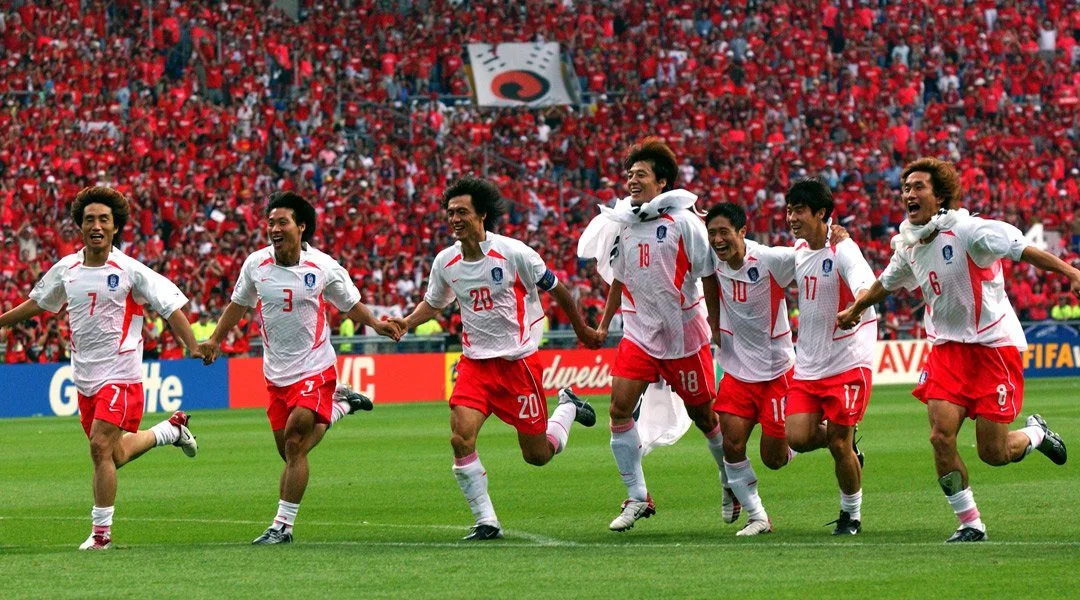
Players on South Korean's national team run arm in arm, emblematic of the unity of the Global Asia tournament hosted by Japan and South Korea in 2002,
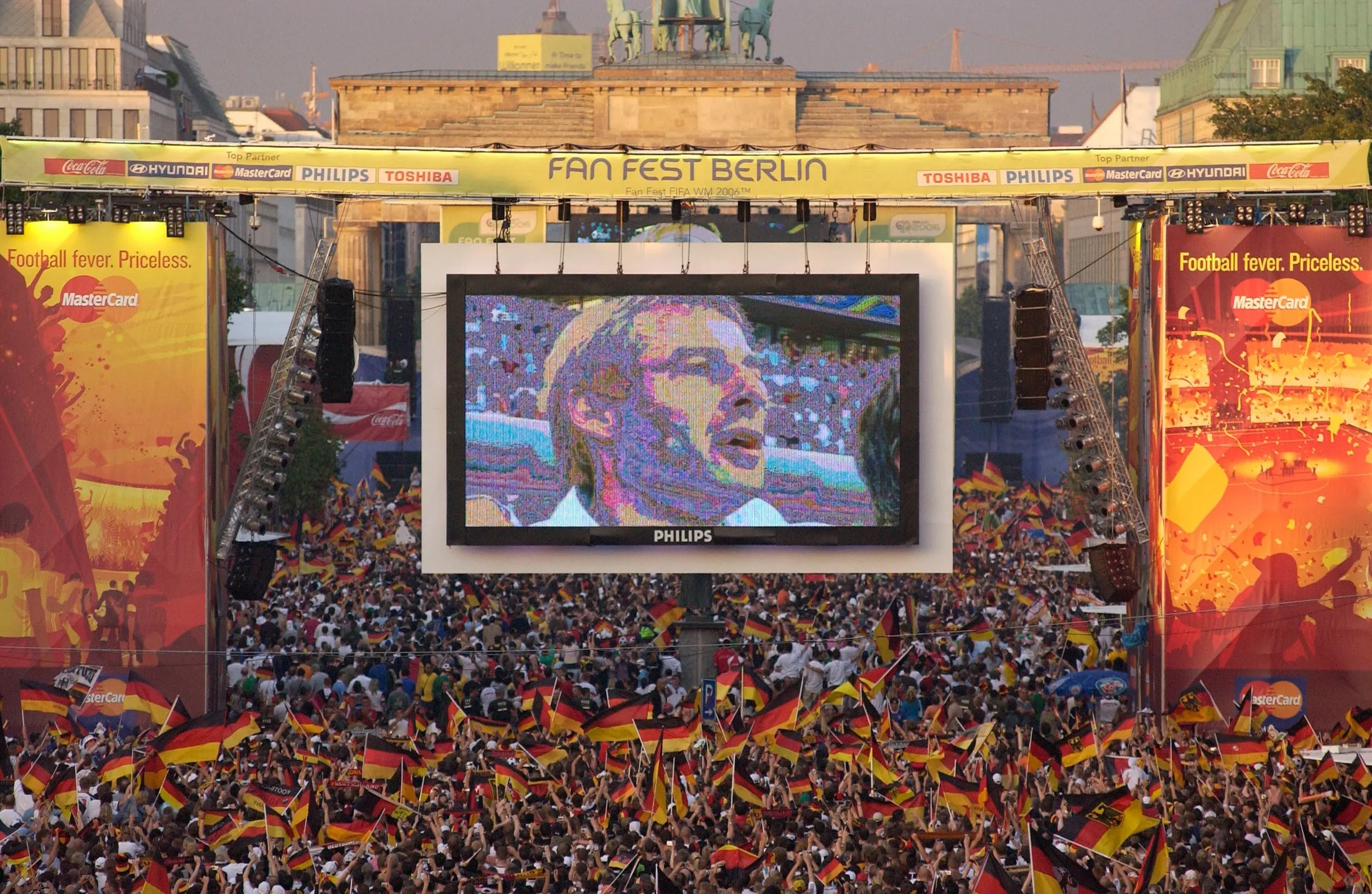
German fans outside the Brandenburg Gate proudly sing along to their national anthem at the 2006 World Cup in Germany.
France 1998: New Faces, Le Triomphe
July 12, 1998, Brazil (0) - France (3)
Victory for Les Bleus against Brazil marked a watershed moment in France’s history. A wave of tricolore national pride swept through the country, culminating in hundreds of thousands converging on Paris for the open-top bus trophy parade after the final. Building on the commercial success of the previous tournament, the 1998 World Cup reached unprecedented global viewership, as “the cumulative television audience for the 64 matches was nearly 40 billion - the biggest ever audience for a single event.”
The defining narrative of the tournament lay in the composition of the French team itself. A diverse squad featuring players of African, Caribbean and North African descent from many former French colonies suffered discrimination off the pitch while dazzling fans with their brilliant footballing abilities on the pitch. Led by the generational Algerian-French superstar Zinedine Zidane, the squad received the nickname “Black-Blanc-Beur” or (Black, White Arab). Not only did the talented group silence domestic and international critics, but they rejuvenated French football on a global scale and paved the path for future teams (and World Cup winning squads) that would contain more racial diversity than most nations.
Though the Cold War had ended, this tournament also featured match-ups between heated political rivals. The United States and Iran squared off less than two decades after the 1979 Revolution and ensuing American hostage crisis in a match ending in a 2-1 defeat for the Americans. It would not be the first time the United States and Iran faced off on the pitch in the World Cup or off the pitch with a World Cup looming.
France 1998 demonstrated how the World Cup could serve as a platform for the negotiation of national identity and international relationships. Squads reflected the changing racial makeup of their societies and allowed nations to show strength in diversity, representation and the power of sport in their public diplomacy strategies.
Japan & South Korea 2002: Stronger Together
June 30, 2002, Germany (0) - Brazil (2)
Japan and South Korea jointly hosted the first World Cup in Asia and the first co-hosted tournament, using the event to ease lingering hostilities rooted in the legacy of the Second World War. Studies of the principal barriers to ending these tensions found a “victim mentality of the Korean towards the Japanese” and a “lack of awareness of Korea in Japan” challenged bilateral relations. 37A shared bid between Seoul and Tokyo proved to be an emphatic step in kickstarting the reconciliation process.
In an effort to promote regional interests, Japan and Korea selected “Global Asia” for the projection of unified messaging and commercial branding. Advances in information technology served as a crucial nexus between Japanese and Korean pop culture, with digital media joining radio and television as mediums to connect cultures A focus on regional cooperation also encouraged the hosts to think beyond their borders and welcome collaboration and investment from their neighbors for mutual benefit.
The World Cup concluded on June 30, with the Three R’s (Ronaldo, Rivaldo, Ronaldinho) leading Brazil to lift the trophy over Germany. In the afternoon of July 1, Japanese Prime Minister Junichiro Koizumi met with Korean President Kim Dae-jung to establish the “Japan-ROK Joint Projects for the Future” as a means to solidify their bilateral diplomatic, economic and cultural relations. This accord and others signed included additional diplomatic visits of Japanese and Korean leaders to each other’s countries, security cooperation, and the launch of a joint history study. This longitudinal study of economic exchange between the two nations following the tournament showed a much more favorable trade relationship and less animosity in public polls over time. Co-hosting the World Cup proved that in an era of globalization, the tournament held the power to heal generational wounds and reshape relationships between nations.
Germany 2006: Softening German Nationalism
July 9, 2006, Italy (1) - France (1); penalties after Extra Time, 5-3
The 2006 World Cup offered Germany an opportunity to present a more relaxed and outward-facing national identity, moving beyond years of post-war caution. Branded as the “Sommermärchen” (summer fairytale), the tournament encouraged Germans to feel easygoing and show forms of public patriotism that had long been taboo in German society.
South Africa lost its host bid by just one vote in 2000 despite support from FIFA President Sepp Blatter and Brazil. As a result, expectations were high for Germany to hold a tournament that transcended political disputes and instead promoted global unity. Among older Germans, blatantly patriotic celebrations were discouraged, while younger Germans relished the chance to “shed their uptight image in favor of an image of a fun-loving rejoicing people.” Flags, fan festivals, and public gatherings were all elements of palatably celebrating the host team, which managed a strong third-place finish.
Aside from Zidane’s infamous red card for a headbutt in the World Cup Final, the tournament was well received from a diplomatic and economic standpoint. A report from the German government after the competition revealed record-high revenue from the competition, adding 300 million euros to its tourism industry, 2 billion euros to retail sales, 40 million euros for its treasury, 56.5 million euros for the German Soccer Federation (DFB) and German Soccer League (DFL) and 50,000 new jobs to the economy. The tournament allowed Germany to successfully recalibrate its national identity, transforming historical caution into confidence and pride as an acceptable means of soft power.
Part V: 2010–2022 (coming soon)
References
Lanfranchi, Pierre. “Italy and the World Cup.” Italian Politics 6 (1992): 158–69. http://www.jstor.org/stable/43041815
Hall, Richard. “Pride, Passion and Tears: Italy’s 1990 World Cup Campaign.” Pride, passion and tears: Italy’s 1990 World Cup campaign -, March 30, 2015. https://www.gentlemanultra.com/2015/03/30/pride-passion-and-tears-italys-1990-world-cup-campaign/.
Lawrence, Amy. “Why Italia 90 Was Not Beautiful to Everyone, but Will Always Be Special | Amy Lawrence.” The Guardian, June 15, 2015. https://www.theguardian.com/football/blog/2015/jun/15/italia-90-world-cup-special.
Santoro, Gabriele. “Kissinger, Diplomacy and Sport: From Ping Pong to USA ’94 ].” StereoType Magazine ], July 31, 2023. https://www.stereotypemag.com/2019/07/22/kissinger-diplomacy-sport-ping-pong/.
Kratz, Jessie. “Teamwork on and off the Field: 1994 FIFA World Cup.” National Archives and Records Administration, November 16, 2022. https://prologue.blogs.archives.gov/2022/11/16/teamwork-on-and-off-the-field-1994-fifa-world-cup/.
Schelfout, Sam. “‘a Palpable Sense of Nostalgia’ – Press Coverage of Post-Cold War Legacies at the 1994 FIFA World Cup.” Sport in American History, May 3, 2019. https://ussporthistory.com/2019/05/02/a-palpable-sense-of-nostalgia-press-coverage-of-post-cold-war-legacies-at-the-1994-fifa-world-cup/.
“1994 FIFA World Cup (USA ’94).” U.S. Soccer Official Website. Accessed April 27, 2024. https://www.ussoccer.com/history/us-soccer-as-host/1994-fifa-world-cup#:~:text=The%20cumulative%20attendance%20of%203%2C587%2C538,also%20established%20a%20new%20mark.
“France 1998: Platini Admits World Cup 98 Was Deliberately Set up for France vs Brazil Final.” MARCA , May 18, 2018. https://www.marca.com/en/world-cup/2018/05/18/5afec46346163fa6708b45c2.html.
Dauncey, H., & Hare, G. (2000). WORLD CUP FRANCE ’98: Metaphors, Meanings and Values. International Review for the Sociology of Sport, 35(3), 331-347. https://doi.org/10.1177/101269000035003006
Sire, Adeline. “After France Won the 1998 World Cup, French Diversity Was Celebrated. but It Was Short-Lived.” The World from PRX, June 29, 2018. https://theworld.org/stories/2018/06/29/after-france-won-1998-world-cup-french-diversity-was-celebrated-it-was-short.
Billingham, Neil. “USA vs Iran at France ’98: The Most Politically Charged Game in World Cup History.” fourfourtwo.com, April 1, 2022. https://www.fourfourtwo.com/features/usa-vs-iran-france-98-most-politically-charged-game-world-cup-history.
Cha, Victor D. “Japan-Korea Relations: The World Cup and Sports Diplomacy.” Project on American Alliances in Asia. Accessed April 27, 2024. https://cc.pacforum.org/wp-content/uploads/2017/06/0202qjapan_korea.pdf.
SAKAEDANI, AKIKO. “2002 FIFA World Cup and Its Effects on the Reconciliation between Japan and the Republic of Korea.” Japanese Journal of Political Science 6, no. 2 (2005): 233–57. https://doi.org/10.1017/S1468109905001854.
“Japan-Republic of Korea Summit Meeting.” MOFA. Accessed April 27, 2024. https://www.mofa.go.jp/region/asia-paci/korea/pv0206/summit.html.
Heere, Bob & Kim, Chiyoung & Yoshida, Masayuki & Nakamura, Hidemasa & Ogura, Toshiyuki & Chung, Kyu & Lim, Soyoun. (2012). The Impact of World Cup 2002 on the Bilateral Relationship Between South Korea and Japan. Journal of Sport Management. 26. 127-142. 10.1123/jsm.26.2.127.
Longman, Jere. “Political Football: Germany Lands the 2006 World Cup.” The New York Times, July 7, 2000. https://www.nytimes.com/2000/07/07/sports/soccer-political-football-germany-lands-the-2006-world-cup.html.
Miller, Jade. “World Cup Diplomacy.” USC Center on Public Diplomacy, August 27, 2006. https://uscpublicdiplomacy.org/blog/world-cup-diplomacy.
World Cup Report .” dw.com, December 7, 2006. https://www.dw.com/en/germanys-world-cup-report-hails-economic-social-success/a-2263053.