Total Football: A Comprehensive History of World Cup Public Diplomacy
Part V - The World Is Watching: Hosting the World Cup in an Era of Global Accountability (2010 - 2022)
This is the fifth part of a series on World Cup Public Diplomacy.
South Africa 2010: This Time for Africa
July 11, 2010, Spain (1) - Netherlands (0)
South Africa fulfilled the vision of its former President and civil rights leader Nelson Mandela when the World Cup came to Africa for the first time in 2010. Framed through a Pan-African lens, the tournament aimed to promote intercultural exchange and political cooperation while challenging international stereotypes. South African leaders sought to project “freedom, solidarity and tolerance” and to create “a better South Africa, a better Africa and a better world.” Shakira, Colombia’s chart-topping and world-famous hitmaker, wrote the anthem “Waka Waka (This Time for Africa)” which fused a melting pot of musical styles and alluded to the 1986 Cameroonian popular song “Waka Waka.” Defined by vuvuzelas, the iconic and unpredictable Jabulani match ball produced by Adidas, and the thrilling journey of Ghana, the tournament showcased continental pride and thrilled fans across the globe.
Beyond symbolism, the South Africa World Cup also catalyzed institutional and infrastructural reforms. South Africa installed 56 courts in the nine host cities to prevent football hooliganism and violence while implementing longer-term judicial modernizations, security measures, and urban development. These forward-thinking transformations extended into the creation of Brand South Africa, a partnership between the South Africa Football Association (SAFA), FIFA and Adidas to establish a sustainable framework for the success of future international football tournaments held on the continent.
Clear inequities still remained between the predominantly white beneficiaries of economic investment and disregard for the future of Black South Africans persisted. But after decades of underinvestment and a lack of attention in the continent, the tournament was a key milestone for the growth and development of football and international investment in Africa.
Brazil 2014: Mais que Futebol
July 13, 2014, Germany (1) - Argentina (0)
Brazil hosted the 2014 World Cup seeking to project itself as more than a nation of the Seleção, samba and carnival – aiming instead to present the image of an emerging economic power and leading voice in the Global South. Former and current President Luiz Inácio Lula da Silva spearheaded Brazil’s successful hosting bid in 2007, proclaiming “Football is not a sport for us. It’s more! It’s a national passion.” Brazil met FIFA’s demands before the tournament to spend $11.3 billion on its economic infrastructure and to implement comprehensive judicial reforms – similar to the previous tournament – to meet the organization’s high expectations.
Protests over wasteful government spending and socioeconomic inequalities, paired with an IOC report expressing doubt upon the safety of stadium infrastructure, gave the tournament a bleak start. On Twitter, the hashtag “imaginanacopa” or “imagine the cup” went viral as users predicted a pending doom for the World Cup. Some reports emerged that FIFA leadership requested President Dilma Rousseff not to speak at the Opening Ceremony to avoid a frenzy of negative backlash.
The tournament itself unfolded under this cloud of scrutiny. Diplomatic friction arose Brazil’s criticism of Israeli actions in Gaza. Meanwhile, on the pitch, Brazil’s campaign ended in historic disappointment with a 7–1 semifinal defeat to Germany, a result that became a global symbol of the host nation’s struggles. Israeli Foreign Ministry spokesman Ygal Palmor commented that international law “is not football. In football, when a game ends in a draw, you think it is proportional, but when it finishes 7-1 it's disproportionate.”
Although the tournament achieved strong attendance and global viewership, its broader diplomatic impact was more ambiguous. Rather than consolidating Brazil’s image as a rising global power, the World Cup highlighted internal divisions and governance challenges. It demonstrated the clear risk of global pressures from a World Cup exposing a host nation’s vulnerabilities, transforming a platform for soft power into a stage for scrutiny.
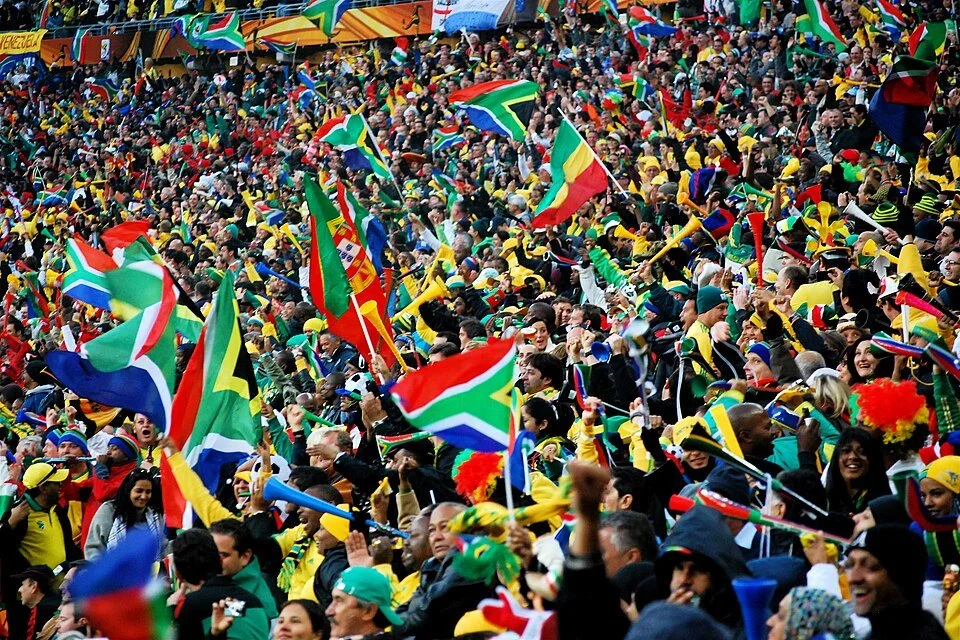
South African flags wave and vuvuzelas blow during the 2010 World Cup.

Fans flock to Copabana Beach in Rio de Janeiro to watch Brazil triumph over Chile in the 2014 World Cup.

President Putin stays dry under an umbrella with FIFA President Gianni Infantino, France President Emmanuel Macron, and Croatia President Kolinda Grabar-Kitarovic in the 2018 World Cup.
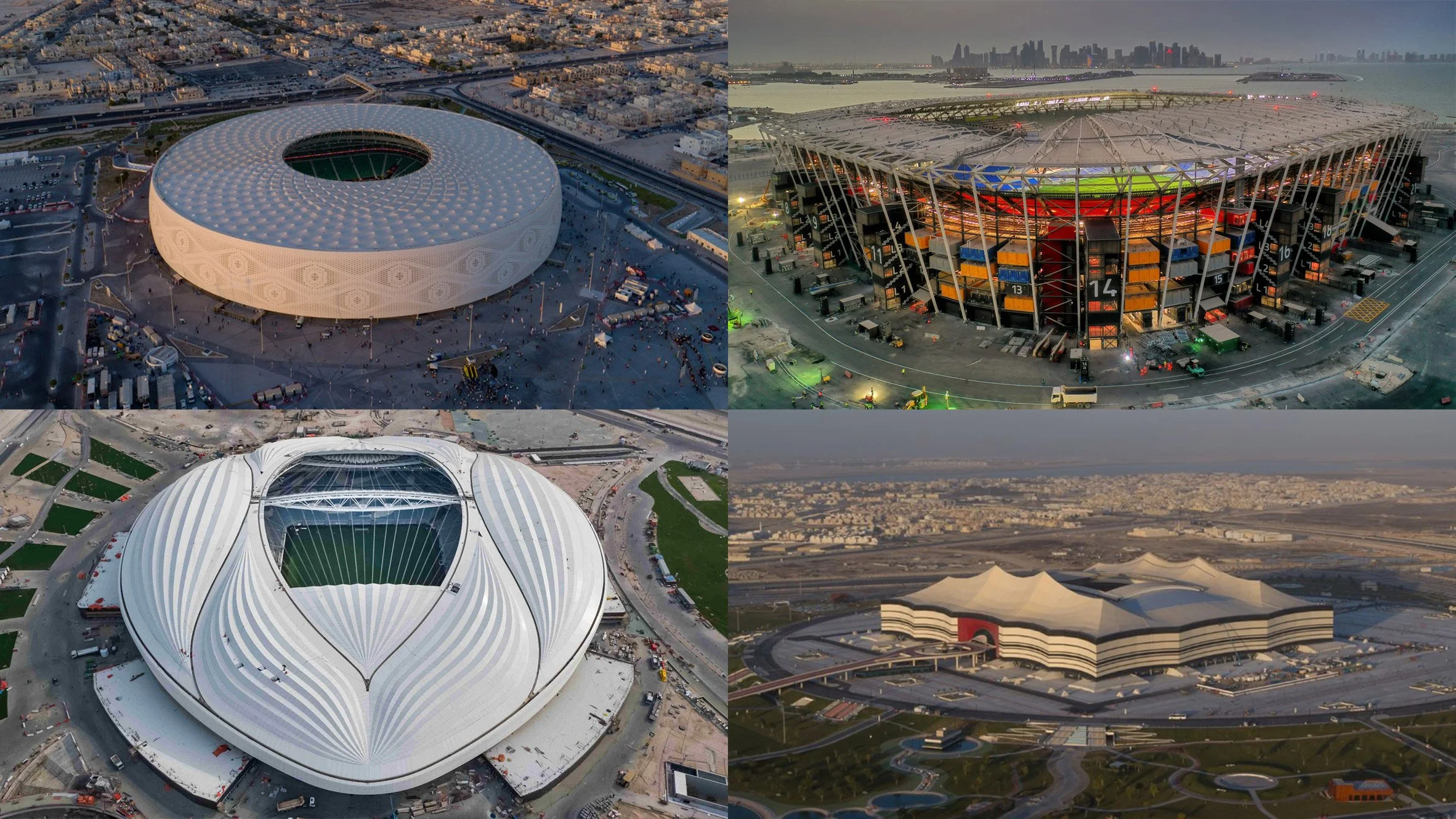
Futuristic stadiums were part of the $200 billion invested in infrastructure and investment for the 2022 Qatar World Cup
Qatar 2022: Arab Winter
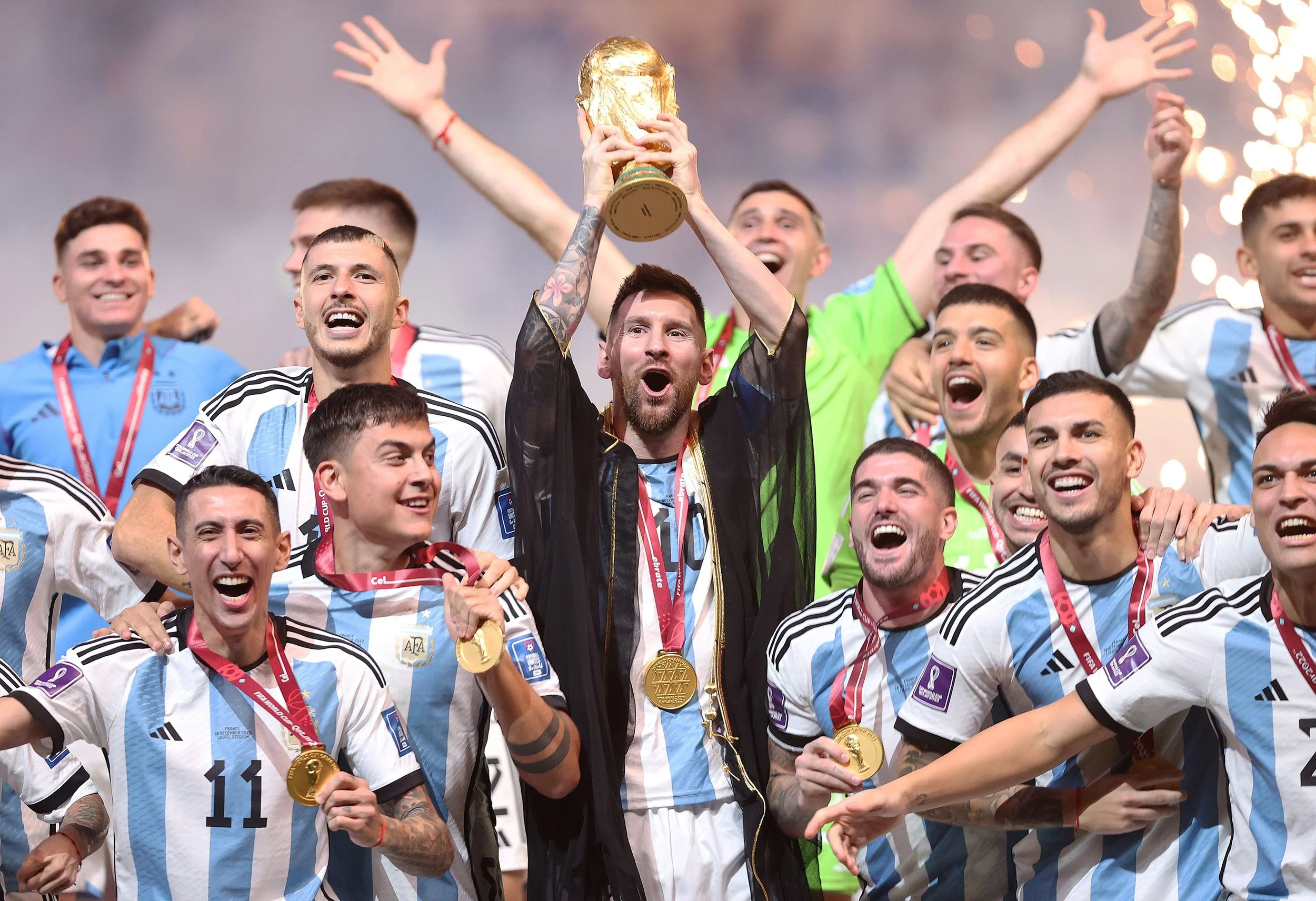
December 18, 2022, Argentina (3) - France (3); penalties after Extra Time, 4-2
The World Cup arrived in the Middle East amid intense global scrutiny over values, as Qatar became the first Arab nation to host the tournament. Awarded hosting rights in 2010, Qatar later was accused by the U.S. Department of Justice of colluding with Russia to use bribery and corruption to jointly secure the 2018 and 2022 bids. In the lead up to the World Cup, especially in the wake of the Arab Spring in the 2010s, Qatari diplomats began the process of improving relations with its neighbors and building new friendships with western allies.
Hosting the World Cup offered Qatar a platform for sports diplomacy, allowing it to engage international audiences and position itself as a bridge between the Middle East and the wider world. Sustained concerns from western governments, media and activists focused on the treatment and reported deaths of migrant workers involved in stadium construction, as well as broader issues related to labor rights, gender equality, and LGBTQ+ protections. These criticisms also stirred dialogue on the grey area between generally accepted human rights protections and a country’s own conservative social norms.
As a result of the discourse, captains from England, Wales, Belgium, Switzerland, Denmark, Germany and the Netherlands planned on wearing “OneLove '' armbands in support of LGBTQ+ rights, but Qatar and FIFA intervened to ban the uniform political protest. Social media served as a platform for political expression, with hashtags such as #boycottqatar2022 reaching over 43 million people in the month preceding the tournament. Qatari officials, including Foreign Minister Mohammed bin Abdulrahman Al Thani Al Thani called boycott protests “nonsense” and defended the country’s transparency in allowing international NGOs to assist with legal and labor reforms.
Despite the political pushback, fans attended and tuned in to the first World Cup to be hosted in the winter in droves. Over 1.5 billion viewers in total watched the World Cup in Qatar, which generated record-breaking revenues of several billion through tourism and longer-term investment. Qatar also invested billions to host the tournament and used significant diplomatic currency to keep support throughout a cascade of controversies. Qatar 2022 represented the culmination of decades of World Cups as more than platforms for competition and national image making.
Tournaments in the modern era serve as a global forum for debates over values, governance, and legitimacy. While the enduring appeal of football prevails, World Cup hosts are now forced more than ever to justify their historic identity, their present realities, and future aspirations, on trial before the world. The 2026 FIFA World Cup hosted by the United States, Canada, and Mexico presents historic opportunities and challenges that will forever shape the future of the tournament and football itself.
Part VI: 2026 FIFA World Cup postlude (coming soon)
Russia 2018: Putin’s Soft Power Play
July 15, 2018, France (4) - Croatia (2)
Russia used the 2018 World Cup as an opportunity to recalibrate its global image following years of strained relations with the West. Although Russia hosted the 2014 Sochi Olympics to much fanfare, it had since transformed into a pariah in the international community for its illegal annexation of the Crimean Peninsula that same year. Under President Vladimir Putin, the tournament was designed to present Russia as a modern and welcoming country to regain trust and standing in the Western world. Media reports of lavish gifts and cash given to former FIFA President Sepp Blatter and other officials also raised questions around FIFA’s decision to host the tournament in the country.
In the opening match, Russia dominated Saudi Arabia 5-0. Off the pitch, Putin hosted Saudi Arabia’s Crown Prince Mohammed bin Salman in the Kremlin to announce close cooperation to bolster global oil prices. UN Secretary General Antonio Guterres, South Korean President Moon Jae-in, and French President Emmanuel Macron were among other eminent heads of state to attend matches. Overtures to soft power seemed to work in Putin’s favor in sanitizing Russia’s image as a friendly country which should be defined by its world-class infrastructure and culture rather than military actions. Security concerns regarding Russia’s notoriously rowdy football hooligans were also largely neutralized by Putin’s tight grip over security and police forces.
France’s national team lifted the trophy in an emphatic victory on Bastille Day, stirring a frenzy of national pride back home. For the host nation, the carefully constructed image proved fragile. While the tournament temporarily softened international perceptions, it did not fundamentally alter Russia’s geopolitical trajectory. The February 2022 invasion of Ukraine would only further isolate the nation from sporting, economic, and political standpoints. The 2018 World Cup stood as an example of the limits of soft power, as momentary rebrands not supplemented by sustainable transformation efforts are only temporary changes to diplomatic perception.
References
Ndlovu, Sifiso Mxolisi. “Sports as Cultural Diplomacy: The 2010 FIFA World Cup in South Africa’s Foreign Policy.” Soccer & Society 11, no. 1–2 (2010): 144–53. doi:10.1080/14660970903331466.
Haslinsky, Anna. “The Almighty FIFA and Brazil’s Great Concessions.” Villanova University, July 28, 2014.https://www1.villanova.edu/villanova/law/academics/sportslaw/commentary/mslj_blog/journal_archives/2014/0728.html.
Laverty, Alex. “Beyond 2010: A Public Diplomacy Strategy for South Africa.” The African File, March 6, 2012. https://theafricanfile.com/public-diplomacy/beyond-2010-a-tripartite-public-diplomacy-strategy-for-south-africa/.
Hindley, David. “The World Cup – an Exercise in Soft Power That Did Not Go to Plan for Brazil.” The Conversation, September 13, 2022. https://theconversation.com/the-world-cup-an-exercise-in-soft-power-that-did-not-go-to-plan-for-brazil-28939.
Freitas Couto, Euclides de, and Alan Castellano Valente. “The World Cup Is Ours!: The Myth of Brazilianness in Lula’s Diplomatic Rhetoric, 2007–2014.” In Soccer Diplomacy: International Relations and Football since 1914, edited by Heather L. Dichter, 198–220. University Press of Kentucky, 2020. https://doi.org/10.2307/j.ctv12sdv7x.14
“Brazil’s Public Diplomacy Ahead of the World Cup.” IPDGC Smart Power, June 11, 2014. https://blogs.gwu.edu/ipdgcsmartpower/2014/06/11/brazils-public-diplomacy-ahead-of-the-world-cup/.
Taylor, Adam. “Israel Calls Brazil a ‘Diplomatic Dwarf’ – and Then Brings up World Cup Humiliation -.” Washington Post, July 25, 2014. https://www.washingtonpost.com/news/worldviews/wp/2014/07/25/israel-brings-up-brazils-world-cup-humiliation-and-calls-the-country-a-diplomatic-dwarf/.
Soares e Castro, Andreia. “The 2018 FIFA World Cup: The Gains and Constraints of Russia’s Soft Power of Attraction through Football and Sports.” Rising Powers in Global Governance, December 2018. https://risingpowersproject.com/fifa-world-cup-2018/.
Hodge, Nathan. “Amid the World Cup, Putin Scores Diplomatic Goals.” CNN, June 20, 2018. https://www.cnn.com/2018/06/20/europe/putin-russia-world-cup-diplomatic-goals-intl/index.html.
“The World Cup in Russia: A Boon for Public Diplomacy.” PONARS Eurasia, June 21, 2018. https://www.ponarseurasia.org/the-world-cup-in-russia-a-boon-for-public-diplomacy/.
Mirgani, Suzi. “Qatar’s Foreign Policy and the 2022 World Cup.” Center for International and Regional Studies, November 10, 2022. https://cirs.qatar.georgetown.edu/qatars-foreign-policy-and-the-2022-world-cup/.
“Study Examines Qatar World Cup Controversy and Boycott.” Montclair State University, November 18, 2022. https://www.montclair.edu/newscenter/2022/11/18/study-examines-qatar-world-cup-controversy-and-boycott/.
Barthe, Benjamin, and Clément Martel. “2022 World Cup: Qatar’s Foreign Minister Denounces ‘Hypocrisy of Attacks.’” Le Monde.fr, November 7, 2022. https://www.lemonde.fr/en/international/article/2022/11/07/2022-world-cup-qatar-s-foreign-minister-denounces-hypocrisy-of-attacks_6003210_4.html#:~:text=Mohammed%20ben%20Abderrahmane%20Al%20Thani,before%20the%20tournament%20kicks%20off.
Vercesi, Ginevra. “Qatar FIFA 2022 World Cup: A Game of Sports Diplomacy Mixed with International Scrutiny.” International Relations Review, March 28, 2023. https://www.irreview.org/articles/qatar-fifa-2022-world-cup-a-game-of-sports-diplomacy-mixed-with-international-scrutiny#:~:text=The%202022%20World%20Cup%20in,efforts%20to%20build%20ties%20elsewhere.